
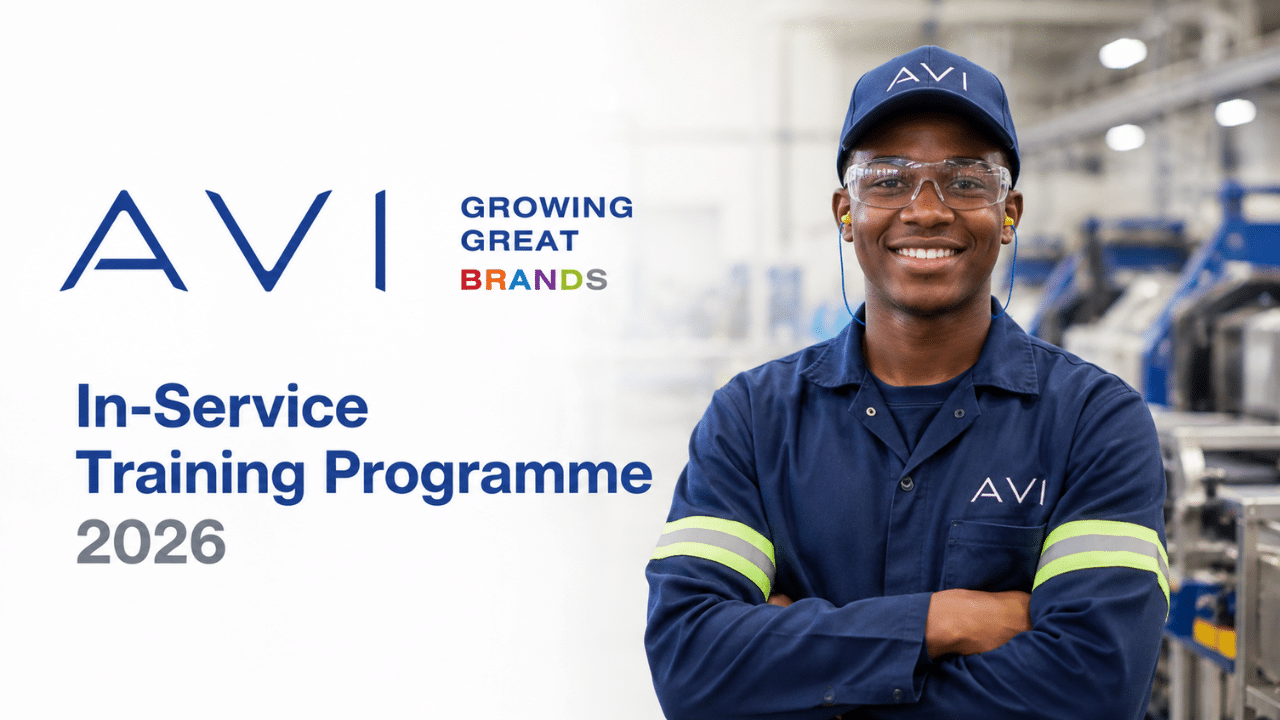
For Food Technology students, completing the academic side of a qualification is only part of becoming industry-ready. The real learning often begins inside a production facility, where food safety standards, laboratory testing and quality systems have to work together every day. In-service training can provide that missing bridge between what students learn at college or university and what is expected inside a large-scale food manufacturing environment.
AVI Limited, through National Brands Limited (NBL), is offering a 12-month Quality In-Service Training Programme for 2026 at its Durban Tea Factory in South Beach, Durban. The opportunity is aimed at candidates with a two-year Food Technology Diploma, including students who require one year of in-service training to complete their studies.
About the AVI Limited In-Service Training Programme 2026
Successful candidates will join National Brands Limited’s Durban Tea Factory as Quality In-Service Trainees.
National Brands Limited forms part of AVI Limited and produces several well-known South African tea brands at the facility, including:
- Five Roses
- Freshpak
- Trinco
The trainees will report to the Quality Manager and gain practical experience within the factory’s quality environment.
Programme Overview
Company: AVI Limited / National Brands Limited
Programme: Quality In-Service Training Programme 2026
Position: Quality In-Service Trainee
Location: South Beach, Durban
Facility: NBL Durban Tea Factory
Duration: 12 months
Contract: Fixed-term
Field: Food Technology / Quality
Who Can Apply?
Candidates should have:
A completed two-year Food Technology Diploma
or be:
Students who require one year of in-service training to complete their studies.
This makes the programme particularly relevant to Food Technology students who have completed their theoretical studies but still need the practical workplace component required for their qualification.
What Will Trainees Learn?
The programme provides experiential learning through exposure to several important areas of food manufacturing and quality management.
These include:
- Food Safety
- In-process Quality
- Incoming laboratory samples
- Quality Systems
Rather than observing from the sidelines, trainees will gain experience within an operating manufacturing facility.
Food Safety Exposure
Food safety is fundamental to large-scale food production.
Trainees will gain practical exposure to the systems and processes used to maintain appropriate food-safety standards within a production environment.
This can help students understand how principles studied academically are implemented during real manufacturing operations.
In-Process Quality
Quality control doesn’t only happen after a finished product leaves the production line.
Trainees will gain exposure to in-process quality, helping them understand how products and production processes are monitored while manufacturing is taking place.
This type of experience can be particularly valuable for candidates interested in future careers in:
- Quality Assurance
- Quality Control
- Food Manufacturing
- Food Safety
- Laboratory Operations
Laboratory Experience
The programme also provides exposure to incoming laboratory samples.
For Food Technology students, this can help develop a practical understanding of how testing and quality information support decisions within a manufacturing environment.
Candidates should therefore be comfortable working accurately with data, results and documentation.
Quality Systems
Another important area of experiential learning will be Quality Systems.
Large food manufacturers depend on structured systems to maintain consistency, traceability and compliance.
Exposure to these systems can give trainees a broader understanding of how quality is managed beyond individual laboratory tests or production-line inspections.
Exposure to New Product Development
AVI also highlights involvement in NPD project trials.
NPD refers to New Product Development.
This gives trainees the potential to see how new or improved products move through testing and trial processes within an established FMCG manufacturing business.
What AVI Offers In-Service Trainees
According to the programme description, trainees can expect:
- Practical learning in a real working environment
- Exposure to genuine business challenges
- Mentorship
- Guidance and support
- Meaningful workplace responsibilities
- Opportunities to contribute ideas
- Accountability for quality and delivery
- Exposure to NPD project trials
The emphasis is therefore on active workplace participation rather than simply completing the required in-service hours.
Additional Requirements
Candidates should also demonstrate:
- Computer literacy
- Ability to work with data
- Reporting ability
- Data-analysis skills
- Leadership ability
- Good verbal communication
- Initiative
- Ability to work independently
- Ability to work effectively within a team
Applicants must also be prepared to work irregular hours when required.
Data and Reporting Skills Matter
Food-quality environments generate significant amounts of information.
AVI specifically wants candidates who can use computers for:
Data reporting and analysis.
Food Technology students with experience using Excel or similar tools for laboratory results, calculations, graphs or academic projects should consider highlighting those skills on their CV.
Be Prepared for a Factory Environment
Candidates should understand that this isn’t purely an office or laboratory placement.
The opportunity is based at an operational tea manufacturing facility, and trainees may gain exposure to different areas of the production and quality environment.
Applicants should therefore be comfortable with the practical realities of working within a manufacturing operation, including the requirement to work irregular hours.
Who Should Consider Applying?
This programme could be particularly suitable for candidates who:
- Have studied Food Technology
- Need in-service training to complete their qualification
- Want food-manufacturing experience
- Are interested in quality assurance
- Enjoy laboratory and analytical work
- Want exposure to food-safety systems
- Are interested in FMCG manufacturing
- Can work in Durban for the 12-month programme
It could also provide useful early-career experience for candidates interested in pursuing careers in food quality, manufacturing or product development.
Thabang Maimela’s Tip
If you’re applying because you need in-service training to complete your Food Technology qualification, make that extremely clear near the top of your CV. Recruiters shouldn’t have to work out whether you meet the programme’s academic purpose.
Also highlight practical modules involving food safety, microbiology, quality control, laboratory testing, data analysis or product development. You may not have formal work experience yet, but relevant practical work completed during your studies can still demonstrate that you have a foundation for the role.
How to Apply for the AVI Limited In-Service Training Programme 2026
Candidates should apply through the official AVI Limited recruitment channel for the Quality In-Service Traineeopportunity at National Brands Limited’s Durban Tea Factory.
Applicants should prepare relevant supporting documents, which may include:
- Updated CV
- Food Technology academic record
- Diploma or available academic results
- Letter confirming in-service training requirements, where applicable
- Identification document
- Other documents requested through the application portal
Students who require the placement to complete their qualification should ensure their academic status and in-service training requirements are clearly documented. Apply Now
12 Months of Practical Food Technology Experience
The AVI Limited In-Service Training Programme 2026 offers Food Technology students an opportunity to spend 12 months developing practical skills inside the National Brands Durban Tea Factory.
With exposure to food safety, laboratory samples, in-process quality, Quality Systems and New Product Development trials, the programme can give participants experience across several important areas of modern food manufacturing.
For Food Technology students who need one year of practical training to complete their studies, this opportunity could provide both the required experiential learning and valuable exposure to a major South African FMCG manufacturing environment.
Closing Date: 14 September 2026
Disclaimer
CareersPursuit shares publicly available opportunities for informational purposes only and is not affiliated with the companies or organisations mentioned unless explicitly stated otherwise. Do not send your personal information, CV, or applications directly to CareersPursuit. Always verify opportunity details through official channels before applying.
- About the Author
- Latest Posts

I am Thabang Maimela, Founder and Editor of CareersPursuit and YouthSETA, two South African platforms dedicated to helping individuals access employment opportunities, skills development programmes, and career growth resources. Through CareersPursuit, I focus on jobs, internships, apprenticeships, graduate programmes, learnerships, and career advice, while YouthSETA specialises in SETA learnerships, skills programmes, youth development initiatives, and workplace readiness resources. My mission is to make reliable, up to date information more accessible, helping South Africans build skills, improve employability, and navigate their career journeys with confidence. Read more about the author on the About Us page.