
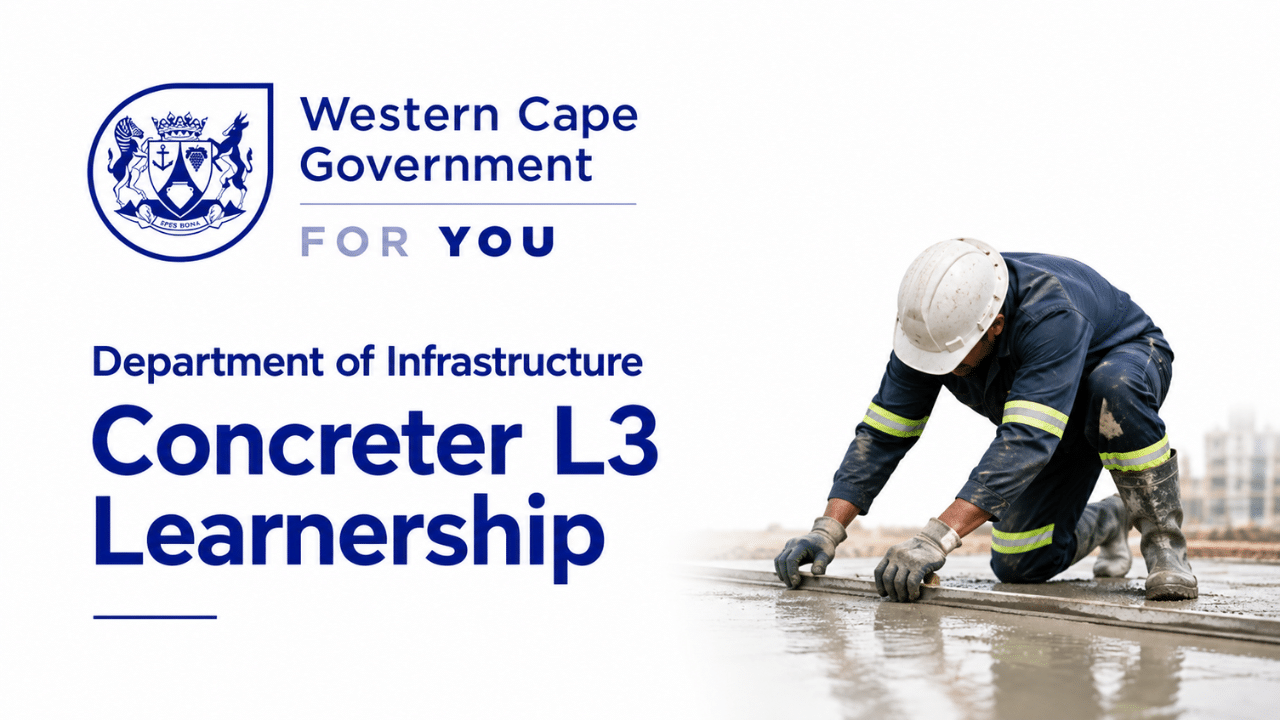
For young people interested in construction and civil engineering, concrete work can provide a practical entry point into an industry responsible for building roads, public infrastructure and other structures. Learning how concrete is produced, placed, tested and finished can establish a useful technical foundation for further development within the construction sector.
The Department of Infrastructure is offering a Concreter Level 3 Learnership for candidates with qualifications from Grade 11, N2, NCV Level 3 or NQF Level 3, with successful learners receiving a R2,000 transport or accommodation allowance.
Department of Infrastructure Concreter L3 Learnership: Quick Overview
- Organisation: Department of Infrastructure
- Programme: Concreter L3 Learnership
- Field: Construction / Civil Engineering
- Level: NQF Level 3
- Minimum education: Grade 11 / NQF Level 3 / NCV Level 3 / N2
- Previous trade experience: Advantageous
- Training: Concrete production, placement, testing and supervision
- Transport or accommodation allowance: R2,000
What Is the Concreter L3 Learnership?
The programme is designed to equip learners with practical competencies involved in working with concrete on construction and civil engineering sites.
Successful candidates will learn about the complete concreting process, beginning with receiving and handling materials and progressing through concrete production, placement, finishing, curing and testing.
The programme also includes exposure to supervising concrete activities and teams.
Minimum Qualification Requirements
Applicants should have one of the following:
- NQF Level 3
- Grade 11
- NCV Level 3
- N2
Experience in the advertised trade will be an advantage.
This means previous exposure could strengthen an application, but it isn’t described as an absolute requirement.
What Will Learners Be Trained to Do?
The programme covers several stages of concrete work.
Learners will develop skills involving:
- Procuring concrete materials
- Receiving construction materials
- Handling materials correctly
- Storing materials
- Producing concrete
- Transporting concrete
- Placing concrete
- Compacting concrete
- Finishing concrete
- Curing concrete
- Testing concrete
- Supervising concreting activities
This provides exposure to both practical site work and aspects of coordinating concrete operations.
Concrete Production
Learners will develop an understanding of how concrete is produced for construction and civil engineering applications.
This begins before the concrete is mixed.
Participants will learn how to:
- Procure materials
- Receive materials on site
- Handle them correctly
- Store materials appropriately
- Prepare for concrete production
Correct material handling is important because the quality of the finished concrete can depend on how its components are prepared and managed.
Placing, Compacting and Finishing Concrete
Once concrete has been produced, learners will receive practical exposure to the processes required to place it correctly.
Training includes:
- Transportation
- Placement
- Compaction
- Finishing
- Curing
Each stage contributes to the quality and durability of the completed concrete work.
Concrete Testing
The programme also covers plant and in-situ testing of concrete.
Testing allows construction teams to assess whether concrete meets the required specifications and quality standards.
This gives learners exposure to the quality-control side of concrete work rather than only the physical construction activities.
Supervisory Skills
Interestingly, the programme goes beyond basic concrete handling.
Learners will also develop competencies related to supervising:
- Concrete production
- Concreting activities on site
- Concreting teams
These skills could become increasingly valuable as learners gain experience within construction and civil engineering environments.
Other Areas Mentioned in the Requirements
The programme information also references several areas of work, including:
- Facility maintenance
- Roadworks
- Environmental cleaning
- Street sweeping
- Bin washing
- Site cleaning
- Waste management
- Renewable energy
- Solar energy
- Wind energy
Applicants with previous exposure to these areas should include relevant experience in their applications where applicable.
R2,000 Transport or Accommodation Allowance
Successful learners will receive a:
R2,000 transport or accommodation allowance.
Applicants should note that the information describes this specifically as a transport or accommodation allowance, rather than simply referring to it as a salary.
Candidates should check the official programme documentation for any further conditions attached to the allowance.
Who Should Consider Applying?
The programme could be particularly relevant to candidates interested in:
- Construction
- Civil engineering
- Roadworks
- Concrete work
- Infrastructure development
- Facility maintenance
- Practical site-based work
Candidates with previous construction or concreting exposure should highlight it because experience in the advertised trade is specifically listed as advantageous.
Thabang’s Tip
Don’t assume concreting simply means mixing and pouring concrete.
Look at what this programme actually covers: material handling, production, placement, compaction, finishing, curing, testing and even supervision.
If you’ve previously worked on construction sites, road projects, concrete work or facility-maintenance projects, describe the actual tasks you performed on your CV instead of simply writing “General Worker.”
For example, if it’s true, experience assisting with concrete mixing, site preparation, formwork, material handling, roadworks or construction-site cleaning could be much more relevant to the recruiter than a generic job title.
And remember: the advertised R2,000 is described as a transport or accommodation allowance, so don’t present it as the programme’s salary unless the official advert separately confirms that.
How to Apply for the Department of Infrastructure Concreter L3 Learnership
Interested candidates should apply through the official application process associated with the Department of Infrastructure Concreter L3 Learnership.
Before applying, prepare your:
- Updated CV
- Identification document
- Grade 11 / NQF Level 3 / NCV Level 3 / N2 qualification
- Relevant certificates
- Proof of previous construction or trade experience, where applicable
Candidates with experience in construction, concrete work, roadworks or related infrastructure activities should make that experience clearly visible in their applications. Apply Now
Closing Date: 30 September 2026
Disclaimer
CareersPursuit shares publicly available opportunities for informational purposes only and is not affiliated with the companies or organisations mentioned unless explicitly stated otherwise. Do not send your personal information, CV, or applications directly to CareersPursuit. Always verify opportunity details through official channels before applying.
- About the Author
- Latest Posts

I am Thabang Maimela, Founder and Editor of CareersPursuit and YouthSETA, two South African platforms dedicated to helping individuals access employment opportunities, skills development programmes, and career growth resources. Through CareersPursuit, I focus on jobs, internships, apprenticeships, graduate programmes, learnerships, and career advice, while YouthSETA specialises in SETA learnerships, skills programmes, youth development initiatives, and workplace readiness resources. My mission is to make reliable, up to date information more accessible, helping South Africans build skills, improve employability, and navigate their career journeys with confidence. Read more about the author on the About Us page.