
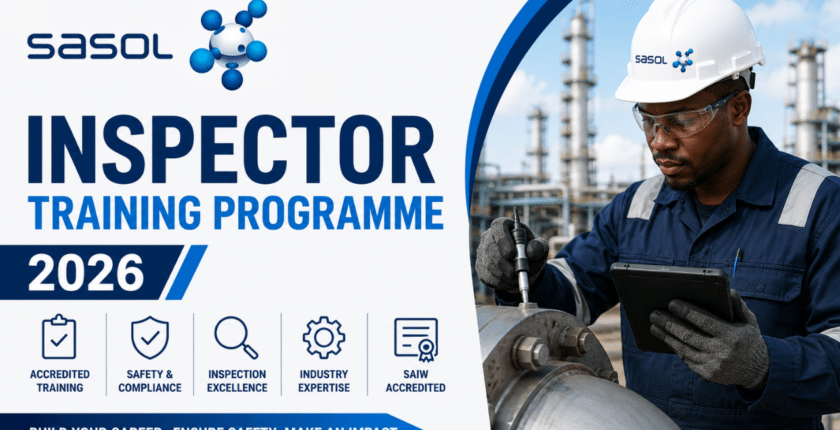
Sasol Inspector Training Programme 2026
Apply for the Sasol Inspector Training Programme 2026. Gain specialised training in pressure equipment inspection, welding inspection, non-destructive testing, and industrial integrity management. No prior experience required.
South African students and aspiring engineering professionals now have an exciting opportunity to enter a highly specialised technical field through the Sasol Inspector Training Programme 2026.
Sasol is inviting applications from ambitious and academically strong candidates who are interested in developing careers in equipment inspection, welding inspection, pressure vessel certification, and industrial integrity management. This fully structured three-year training programme is accredited by the Southern African Institute of Welding (SAIW) and provides a pathway into one of the most specialised and respected technical professions within the engineering industry.
The programme offers extensive theoretical and practical training focused on ensuring the safety, reliability, and compliance of critical industrial equipment used in major petrochemical and manufacturing operations.
About the Sasol Inspector Training Programme
The Inspector Training Programme is designed to develop future inspection professionals who will play a critical role in maintaining the integrity and safety of industrial equipment.
Successful candidates will undergo specialised training in equipment inspection, non-destructive testing, welding inspection, pressure vessel assessment, steam generator inspections, and regulatory compliance.
The programme combines classroom learning with practical workplace exposure, allowing trainees to develop valuable technical knowledge while gaining hands-on experience within one of South Africa’s largest industrial environments.
What Does an Inspector Do?
Inspectors are responsible for ensuring that industrial equipment remains safe, reliable, and compliant with engineering standards and legal requirements.
Their work helps prevent equipment failures, production interruptions, safety incidents, and costly repairs.
Inspectors evaluate the condition of pressure vessels, pipelines, steam generators, structural components, and other critical assets used in industrial operations.
Their findings play a crucial role in determining whether equipment can continue operating safely or requires repair, modification, or replacement.
Areas of Specialisation
Successful trainees will be exposed to several specialised inspection disciplines.
Inspector of Pressurised Equipment (IPE)
The Inspector of Pressurised Equipment is responsible for overseeing the manufacturing, maintenance, repair, and certification of pressurised equipment.
Key responsibilities include:
- Welding inspections
- Material verification
- Compliance certification
- Manufacturing quality reviews
- Repair assessments
- Documentation reviews
Competent Person Inspector (CP)
Competent Person Inspectors focus on ensuring equipment remains safe for continued operation.
Responsibilities include:
- Physical inspections
- Risk assessments
- Equipment certification
- Safety evaluations
- Regulatory compliance inspections
- Equipment condition monitoring
Authorised Inspection Authority (AIA)
AIA Inspectors are responsible for certifying products and equipment according to applicable codes and standards.
Their role ensures equipment meets strict engineering, safety, and legal requirements before being approved for operation.
What You Will Learn During the Programme
Throughout the three-year programme, trainees will gain exposure to advanced inspection methods and technologies used throughout the engineering and petrochemical industries.
Training includes:
- Visual inspections
- Wall thickness measurements
- Magnetic particle testing
- Dye penetrant testing
- Pressure vessel inspections
- Steam generator inspections
- Piping inspections
- Equipment integrity assessments
- Risk-based inspection methodologies
- Technical report writing
- Safety compliance procedures
- Equipment certification processes
Participants will also learn how to interpret technical documentation, engineering drawings, inspection reports, and manufacturing records.
Exposure to Advanced Non-Destructive Testing (NDT)
One of the most valuable aspects of this programme is exposure to advanced Non-Destructive Testing (NDT) technologies.
These specialised inspection methods allow engineers and inspectors to evaluate equipment without causing damage.
Trainees may gain exposure to:
- Ultrasonic Testing (UT)
- Time of Flight Diffraction (TOFD)
- Phased Array Ultrasonic Testing (PAUT)
- IRIS Testing
- Eddy Current Testing
- Guided Ultrasonic Testing (GUL)
- Industrial Radiography
- X-Ray Inspection Technologies
These highly sought-after technical skills are used globally across industries such as oil and gas, mining, manufacturing, aviation, power generation, and petrochemicals.
Minimum Requirements For Sasol Inspector Training Programme 2026
Applicants must meet the following requirements:
- Grade 12 (Matric)
- Minimum 50% in Mathematics
- Minimum 50% in Physical Science
- Minimum 50% in English
Candidates with a completed S4 qualification in:
- Mechanical Engineering
- Metallurgical Engineering
- Welding Engineering
may receive favourable consideration.
Skills and Attributes Sasol Is Looking For
Sasol is seeking individuals who demonstrate:
- Strong analytical abilities
- Excellent communication skills
- High learning potential
- Attention to detail
- Problem-solving capabilities
- Accountability
- Planning and organisational skills
- Commitment to safety
- Technical curiosity
- Professional integrity
The company is looking for candidates who are passionate about engineering and eager to build careers in specialised inspection and equipment integrity fields.
Why This Opportunity Is Unique
Unlike many engineering development programmes, this training programme focuses on a highly specialised profession that remains critical across numerous industries.
Qualified inspectors are often employed in:
- Petrochemical operations
- Oil and gas facilities
- Mining operations
- Manufacturing plants
- Power stations
- Engineering consulting firms
- Inspection authorities
- Construction projects
- Industrial maintenance environments
As industries continue to prioritise safety, compliance, and equipment reliability, skilled inspection professionals remain in high demand.
Career Opportunities After Qualification
Successful completion of the programme can open doors to careers such as:
- Welding Inspector
- Pressure Equipment Inspector
- Competent Person Inspector
- Integrity Engineer
- NDT Specialist
- Quality Assurance Inspector
- Equipment Reliability Specialist
- Inspection Consultant
- Technical Compliance Specialist
These careers often provide opportunities for continuous professional development and international recognition.
Thabang Maimela‘s Tip
Many students focus only on traditional engineering careers such as electricians, fitters, and mechanical technicians. Specialised fields like inspection, equipment integrity, and non-destructive testing often offer excellent long-term career prospects because these skills remain essential in every major industrial sector. If you meet the requirements, this is one opportunity worth serious consideration.
Explore More Opportunities on CareersPursuit
- Available Internships In South Africa
- 7 Latest Internships You Should Apply For
- How To Apply For Internships 2026 Guide
Closing Date: 12 June 2026
Apply Now For The Sasol Inspector In Training Programme
Disclaimer
CareersPursuit shares publicly available opportunities for informational purposes only and is not affiliated with the companies or organisations mentioned unless explicitly stated otherwise. Do not send your personal information, CV, or applications directly to CareersPursuit. Always verify opportunity details through official channels before applying.
- About the Author
- Latest Posts

I am Thabang Maimela, Founder and Editor of CareersPursuit and YouthSETA, two South African platforms dedicated to helping individuals access employment opportunities, skills development programmes, and career growth resources. Through CareersPursuit, I focus on jobs, internships, apprenticeships, graduate programmes, learnerships, and career advice, while YouthSETA specialises in SETA learnerships, skills programmes, youth development initiatives, and workplace readiness resources. My mission is to make reliable, up to date information more accessible, helping South Africans build skills, improve employability, and navigate their career journeys with confidence. Read more about the author on the About Us page.