
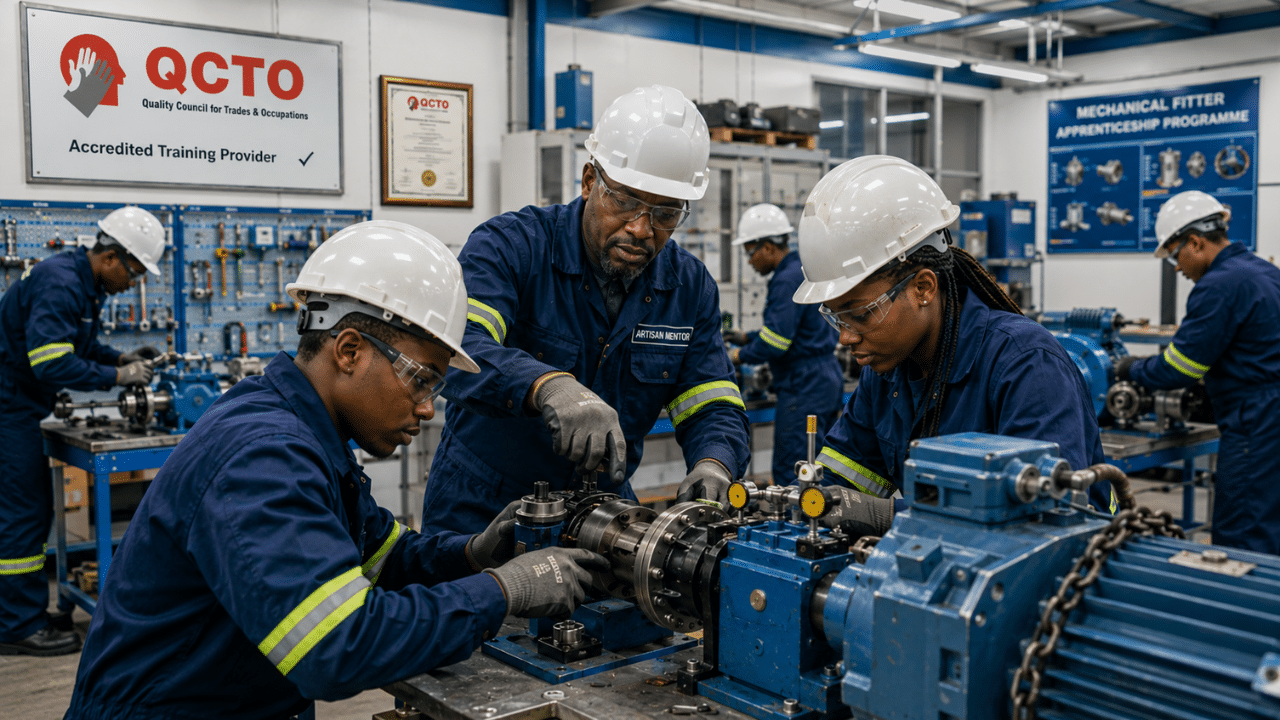
Learn how to become a qualified Mechanical Fitter in South Africa. Discover apprenticeship requirements, merSETA pathways, QCTO standards, trade tests, Red Seal certification, salaries, employers, and career opportunities.
What is a Mechanical Fitter Apprenticeship?
A Mechanical Fitter Apprenticeship is a structured artisan training programme that combines theoretical engineering studies with practical workplace experience to prepare learners for careers in industrial maintenance, manufacturing, mining, power generation, petrochemicals, and heavy engineering.
Mechanical Fitters are responsible for assembling, installing, maintaining, repairing, and optimising industrial machinery and mechanical systems that keep South Africa’s economy running.
The ultimate goal of every Mechanical Fitter apprentice is to successfully complete the National Trade Test and obtain a Red Seal certification recognised throughout South Africa and internationally.
Because every industrial facility depends on machinery, Mechanical Fitters remain among the most important artisans in the engineering sector.
What is Apprenticeships full guide, This guide will help you understand the foundation of apprenticeships.
What Does a Mechanical Fitter Do?
Mechanical Fitters work with a wide range of industrial equipment and systems.
Typical responsibilities include:
- Installing industrial machinery
- Pump maintenance
- Gearbox maintenance
- Conveyor maintenance
- Turbine maintenance
- Compressor maintenance
- Bearing replacement
- Shaft alignment
- Mechanical assembly
- Equipment inspections
- Fault finding
- Preventative maintenance
Their work ensures equipment operates safely, efficiently, and reliably.
Industries That Employ Mechanical Fitters
One of the biggest advantages of this trade is its versatility across industries.
Mining Industry
Mining operations rely heavily on Mechanical Fitters to maintain production equipment.
Major employers include:
- Anglo American
- Exxaro
- South32
- Glencore
- Gold Fields
- Harmony Gold
Energy and Power Generation
Power stations require highly skilled maintenance artisans.
Major employers include:
- Eskom
- Independent Power Producers
Petrochemical Industry
Large industrial facilities require constant equipment maintenance.
Major employers include:
- Sasol
- PetroSA
Manufacturing Industry
Manufacturing facilities depend on reliable mechanical systems.
Examples include:
- ArcelorMittal South Africa
- Bell Equipment
- Babcock
- DCD Group
Rail and Logistics
Rail infrastructure requires extensive engineering maintenance.
Employers include:
- Transnet Engineering
- Transnet Freight Rail
Browse active apprenticeships in South Africa
Understanding Mechanical Systems
Mechanical Fitters work with a variety of industrial systems.
Pumps
Used throughout mining, manufacturing, and petrochemical facilities.
Mechanical Fitters install, repair, and maintain:
- Centrifugal Pumps
- Positive Displacement Pumps
- Process Pumps
Gearboxes
Gearboxes transfer power within industrial machinery.
Fitters perform:
- Alignment
- Repairs
- Bearing Replacements
- Maintenance Inspections
Compressors
Compressors play a vital role in industrial operations.
Mechanical Fitters ensure these systems operate efficiently and safely.
Conveyors
Conveyor systems are critical in:
- Mining
- Manufacturing
- Logistics
- Food Processing
Mechanical Fitters help keep production moving.
Turbines
Power stations and industrial facilities rely on turbines for energy generation.
Mechanical Fitters often participate in turbine maintenance projects.
The Role of merSETA in Mechanical Fitter Apprenticeships
The Manufacturing, Engineering and Related Services Sector Education and Training Authority (merSETA) plays a significant role in supporting artisan development throughout South Africa’s engineering industries.
Many Mechanical Fitter apprenticeship opportunities originate from industries that fall under merSETA’s scope, including:
- Manufacturing
- Engineering
- Automotive Production
- Heavy Industry
- Industrial Maintenance
Through partnerships with employers, TVET Colleges, and training providers, merSETA helps facilitate workplace learning opportunities and artisan development programmes.
For aspiring Mechanical Fitters, understanding merSETA is important because many apprenticeship opportunities are linked to industries supported by the SETA.
Understanding QCTO and NAMB
Every aspiring Mechanical Fitter should understand the organisations responsible for artisan quality assurance.
Quality Council for Trades and Occupations (QCTO)
The QCTO develops occupational qualifications and ensures training programmes meet national standards.
Mechanical Fitter qualifications are developed according to QCTO occupational standards.
National Artisan Moderation Body (NAMB)
NAMB oversees artisan trade testing and moderation across South Africa.
The National Trade Test is conducted under standards monitored by NAMB.
Together, these organisations maintain the quality and credibility of South Africa’s artisan development system.
The Four Blocks Framework
Block 1: Institutional Learning
Most Mechanical Fitter apprentices begin with engineering studies at a TVET College.
Common qualifications include:
- N1 Engineering Studies
- N2 Engineering Studies
- N3 Engineering Studies
- N4 Engineering Studies
- N5 Engineering Studies
- N6 Engineering Studies
Typical subjects include:
- Mathematics
- Engineering Science
- Mechanotechnology
- Engineering Drawing
- Industrial Engineering
These qualifications provide the theoretical foundation required for the trade.
Block 2: Workplace Learning
Practical workplace experience is gained under qualified artisans.
Employers may include:
- Eskom
- Sasol
- Bell Equipment
- ArcelorMittal South Africa
- Anglo American
- Exxaro
- South32
- Babcock
- Transnet Engineering
This phase allows apprentices to apply engineering theory in real industrial environments.
Block 3: Logbook Completion
Throughout the apprenticeship, learners must maintain a workplace logbook documenting practical competencies.
Examples include:
- Pump Maintenance
- Gearbox Maintenance
- Shaft Alignment
- Bearing Installation
- Mechanical Assembly
- Conveyor Maintenance
- Equipment Inspection
- Safety Procedures
The logbook serves as evidence of workplace competence.
Block 4: Trade Test Preparation
Before attempting the National Trade Test, apprentices undergo intensive preparation.
This includes:
- Practical Assessments
- Maintenance Exercises
- Mechanical Fault Finding
- Equipment Diagnostics
- Mock Trade Tests
Successful completion prepares learners for qualification.
Understanding the Red Seal Trade Test
The Red Seal Trade Test is the final assessment required to become a qualified Mechanical Fitter.
The assessment evaluates:
- Practical Skills
- Technical Knowledge
- Equipment Maintenance Competence
- Safety Compliance
Passing the trade test demonstrates that the candidate meets South Africa’s national artisan standards.
A Red Seal qualification significantly improves employment opportunities and career progression opportunities.
Entry Requirements
Requirements vary by employer.
Most programmes require:
Minimum Requirements
- Grade 12 (Matric)
- Mathematics
- Physical Science
- South African Citizenship
- Medical Fitness
Advantageous Qualifications
- N2 Engineering Studies
- N3 Engineering Studies
- Workshop Experience
- Engineering Skills Programmes
Many employers prioritise candidates who already possess technical qualifications.
Major Employers Offering Mechanical Fitter Apprenticeships
Many large organisations regularly recruit Mechanical Fitter apprentices.
Examples include:
- Eskom
- Sasol
- ArcelorMittal South Africa
- Bell Equipment
- Anglo American
- Exxaro
- South32
- Babcock
- DCD Group
- Transnet Engineering
Apprentice Salaries
Apprentices typically receive a training allowance or salary depending on the employer and apprenticeship structure.
Compensation varies according to:
- Industry
- Employer
- Province
- Programme Structure
After qualification, Mechanical Fitters often enjoy strong earning potential due to the demand for maintenance skills.
Career Progression
Mechanical Fitter Apprentice
↓
Qualified Mechanical Fitter
↓
Senior Mechanical Fitter
↓
Maintenance Foreman
↓
Maintenance Supervisor
↓
Engineering Manager
Entrepreneurship Opportunities
Many qualified Mechanical Fitters eventually establish their own businesses.
Examples include:
- Industrial Maintenance Services
- Mechanical Contracting
- Equipment Repair Services
- Plant Maintenance Companies
- Engineering Support Services
This creates opportunities beyond traditional employment.
Scarce Skills Demand
Mechanical Fitters remain among South Africa’s most important engineering artisans.
Demand is driven by:
- Mining Operations
- Manufacturing Growth
- Energy Projects
- Petrochemical Facilities
- Infrastructure Development
- Industrial Maintenance Requirements
As industrial infrastructure expands and ages, the demand for qualified Mechanical Fitters remains strong.
Mechanical Fitters and Industry 4.0
Modern maintenance is becoming increasingly technology-driven.
Today’s Mechanical Fitters often work alongside:
- Predictive Maintenance Systems
- Condition Monitoring Equipment
- Digital Maintenance Platforms
- Smart Manufacturing Technologies
- Industrial Automation Systems
This makes the trade highly relevant in the modern industrial economy.
Thabang Maimela’s Tip
Mechanical Fitter is one of the most underrated artisan careers in South Africa. While many learners focus on Electrician or Millwright opportunities, Mechanical Fitters are the professionals who keep critical industrial equipment running in mines, factories, power stations, and petrochemical plants. The trade offers excellent long-term career stability and progression opportunities.
Frequently Asked Questions
What is a Mechanical Fitter apprenticeship?
A Mechanical Fitter apprenticeship is a structured artisan training programme that combines classroom learning and workplace experience in industrial mechanical maintenance and equipment repair.
Which SETA is linked to Mechanical Fitter apprenticeships?
Mechanical Fitter apprenticeships are commonly associated with merSETA, particularly within manufacturing, engineering, mining, and industrial sectors.
How long does a Mechanical Fitter apprenticeship take?
Most programmes take approximately 3 to 4 years depending on the employer and apprenticeship structure.
What is the difference between a Mechanical Fitter and a Fitter and Turner?
Mechanical Fitters primarily focus on installing, maintaining, and repairing machinery, while Fitter and Turners also perform precision machining and manufacturing of engineering components.
Is Mechanical Fitter a scarce skill in South Africa?
Yes. Mechanical Fitters remain highly sought after across mining, manufacturing, energy generation, and petrochemical industries.
Explore More Apprenticeship Guides
- Electrician Apprenticeship Guide
- Boilermaker Apprenticeship Guide
- Fitter and Turner Apprenticeship Guide
- Millwright Apprenticeship Guide
- Instrumentation Technician Apprenticeship Guide
- Welder Apprenticeship Guide
- Diesel Mechanic Apprenticeship Guide
- About the Author
- Latest Posts

I am Thabang Maimela, Founder and Editor of CareersPursuit and YouthSETA, two South African platforms dedicated to helping individuals access employment opportunities, skills development programmes, and career growth resources. Through CareersPursuit, I focus on jobs, internships, apprenticeships, graduate programmes, learnerships, and career advice, while YouthSETA specialises in SETA learnerships, skills programmes, youth development initiatives, and workplace readiness resources. My mission is to make reliable, up to date information more accessible, helping South Africans build skills, improve employability, and navigate their career journeys with confidence. Read more about the author on the About Us page.